

Your AI chatbot is talking to servers you’ve never heard of
You added an AI chatbot to your WooCommerce store. Customers are asking questions. Products are being recommended. Everything looks fine.
But do you know where every one of those customer conversations is being stored?
Most store owners don’t. They assume their chatbot plugin handles compliance. They signed up, installed the widget, and moved on. What they didn’t realise is that the moment a customer types a question, or speaks one, that data travels through a chain of third-party services, each with their own servers, their own privacy terms, and their own interpretation of what “compliant” means.
This isn’t a hypothetical risk. It’s a live exposure that affects WooCommerce stores on every continent. EU merchants face GDPR enforcement. US merchants face a growing patchwork of state privacy laws. Australian, Canadian, and Southeast Asian merchants face their own frameworks. And in all of these jurisdictions, the question is the same: where does the data actually live?
In this guide, we break down how AI chatbot data residency works, why it matters for your store, and what to look for when you’re choosing a WooCommerce AI chatbot that doesn’t create compliance problems you didn’t know you had.
What is data residency, and why does it apply to your chatbot?
Data residency refers to the physical location where data is stored and processed. When your customer types “do you have this in size M?”, that message is processed by your chatbot’s AI, and stored somewhere on a server.
The question is: where is that server? And whose rules apply to it?
This matters because privacy law is territorial. GDPR applies to data about EU residents, regardless of where the company running the chatbot is based. California’s CCPA applies to data about California residents. Canada, Australia, Singapore…they all have their own rules about where personal data can go and what protections must be in place when it crosses borders.
A chatbot that feels local can be anything but. The widget lives on your site. The AI lives somewhere else entirely.
The hidden chain behind your AI chatbot
Here’s something most chatbot vendors don’t make obvious: a single AI chatbot interaction often passes through several separate services before a response reaches your customer.
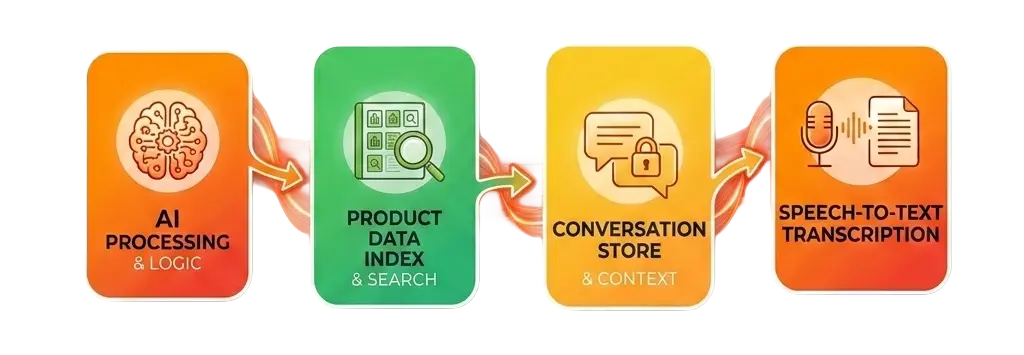
There’s the AI that generates the response. There’s the database where your products and store policies are indexed and searched. There’s the service that stores the conversation history. And if your chatbot supports voice, there’s a separate transcription service that converts spoken words to text before the AI even sees them.
Each of these is a potential data residency exposure. Even if your chatbot vendor is based in the EU, if the transcription service they use runs on US-only servers, your customers’ voice data is leaving the EU with every spoken query, without you knowing about it.
This is not theoretical. When two of the most widely used voice AI platforms were evaluated for EU compliance in early 2026, the finding was unambiguous: neither offered EU data residency by default. The data goes where the infrastructure is, and the infrastructure was in the United States.
Why this matters everywhere, not just Europe
GDPR gets most of the headlines, but data residency is a global issue.
United States: There is no single federal privacy law, but California’s CCPA grants consumers the right to know where their data is stored and processed. Twelve other US states now have similar laws. Storing customer conversation data through services you don’t control, without disclosed agreements, is increasingly a compliance gap, not a technicality.
Canada: Privacy law here requires that organisations using third-party services take responsibility for ensuring adequate protection of customer data. “My vendor handles it” is not a sufficient answer if you can’t demonstrate what protections are actually in place.
Australia: The Privacy Act requires that overseas transfers of personal information meet equivalent protection standards. An AI chatbot routing customer data through infrastructure in other countries requires explicit attention to this.
Southeast Asia: Singapore, Thailand, and Indonesia all have data protection laws that impose obligations on cross-border data transfers. Regional merchants building AI-powered storefronts need to factor this in from the start.
The common thread: regulators everywhere are converging on the same principle. You are responsible for your customer data — including the data your tools process on your behalf. “I didn’t know where it went” is not a defence.
The EU case: what GDPR actually requires
For European merchants, the requirements are the most specific and the enforcement is the most active.
Under GDPR, personal data – including chat conversations, names, and voice recordings – can only leave the EU if adequate protections are in place. Legal transfer mechanisms exist that allow data to move to countries like the US under certain conditions, but these are not the same as keeping data in the EU. They are agreements on paper, not guarantees about where servers are located.
Many EU data protection authorities, and most enterprise procurement teams, now consider actual EU data residency the only fully defensible position. For WooCommerce store owners, the practical question is simple: if a customer or a regulator asked you where their conversation with your chatbot is stored, could you answer?
Most chatbot plugins cannot answer that question. The data defaults to wherever the provider’s primary servers are, usually the US, and the merchant never chose that.
What to look for in a compliant WooCommerce AI chatbot
Not all “GDPR compliant” or “privacy-first” claims are equal. Here’s what to actually verify before choosing a chatbot for your WooCommerce store.
1. Can you choose where your data is stored?
The best implementations let you decide, EU for European stores, US for American stores, and enforce that choice at the infrastructure level, not just in a settings menu.
2. Does the vendor cover all parts of the pipeline?
Ask whether their privacy commitment covers every component: the AI itself, the product search index, the conversation history, and, if voice is involved, the transcription service. A DPA that only covers the vendor’s own servers is not a full answer.
3. Is there a signed Data Processing Agreement (DPA)?
Under GDPR, if a vendor processes personal data on your behalf, you need a signed DPA. If a vendor can’t produce one, that is a red flag regardless of what their marketing says. US and international merchants should look for equivalent processor agreements under their own applicable law.
4. What happens with voice data?
Voice is the most commonly overlooked point. It is more sensitive than text, in several jurisdictions it is treated as biometric data. If your chatbot supports or plans to support voice, confirm explicitly where the transcription happens and under whose privacy terms.
5. Where is your product catalogue indexed?
Your product and knowledge base data is stored and searched somewhere. Ask which country or region that database lives in. It is often a different service from the chatbot itself.
One vendor, one region, one agreement
The cleanest solution to the data residency problem is a chatbot built entirely on a single cloud infrastructure, one that has mature regional data centres and a single privacy agreement that covers the whole stack.
When every component of a chatbot runs on the same cloud platform – the AI reasoning, the product search, the conversation storage, and the voice transcription – all of it can be locked to a single region under a single data processing agreement. EU merchants get EU infrastructure. US merchants get US infrastructure. The choice is made once, at setup, and enforced at the server level.
This is meaningfully different from a chatbot stitching together five separate vendors and asking you to manage five separate compliance relationships, most of which you probably didn’t know existed.
For voice specifically, this matters most. When the transcription service runs on the same infrastructure as the rest of the chatbot, in the same region, under the same agreement, voice data never needs to leave your chosen region. No new vendor. No new compliance gap. No conversation that starts in Brussels and gets transcribed in Virginia.
What this means for Corelex
Corelex is built on a single cloud infrastructure – Google Cloud Platform – from top to bottom. The AI reasoning, the product and knowledge search, the conversation storage, and the voice layer all run on the same platform, in the same region, under the same Google Cloud privacy agreement.
When you install Corelex from your WordPress admin, you choose your data region: EU, US, or Global. That choice is applied at setup, from your WordPress dashboard. No technical configuration. No cloud console. One decision, enforced at the infrastructure level.
For EU merchants, that means your customers’ conversations — including voice interactions — stay within European infrastructure, covered by a single DPA.
For US merchants, the same clarity applies, with US infrastructure.
For merchants in Asia, Australia, or Canada, the Global option gives you a documented storage location and a single agreement to review, not a black box.
Data residency by design, not by policy.
A practical checklist before you install any AI Chatbot
Before activating any AI chatbot on your WooCommerce store, work through these questions:
If a vendor can’t answer these questions clearly, that is itself an answer.
The bottom line
Data residency is not a compliance technicality that only matters to large enterprises. It is a practical question that every WooCommerce store owner should be able to answer: when a customer talks to your AI chatbot, where does that conversation go?
The answer should be one you chose, not one you inherited from a vendor chain you didn’t know existed.
Whether you’re running a store in Brussels, Boston, Brisbane, or Bangkok, your customers’ data deserves to live somewhere you can account for. The tools to make that happen exist. The question is whether the chatbot you’re evaluating was built with that in mind from the start.
Corelex is an AI-powered sales and service agent for WooCommerce. Merchants choose their data region – EU, US, or Global – at setup, directly from their WordPress dashboard. No technical configuration required. See how Corelex works →